
Yucatán Haciendas: Which Henequen Haciendas to Visit (and Stay In)
The Yucatán haciendas are the old henequen estates scattered across the countryside around Mérida, where an agave fibre known as oro verde, green gold, was grown and processed between the late 19th and mid-20th centuries. Today some are museums, one still runs its machinery for visitors, several have cenotes you can swim in, and many have been restored as hotels. This guide covers the history in brief, what to look for when you visit, which haciendas open to day visitors and what to expect if you stay in one.
Oro verde: how henequen built Mérida
Henequen (Agave fourcroydes) is native to the Yucatán, and the Maya used its fibre for rope and cords long before the Spanish arrived. Its stiff leaves grow well in the thin soil over limestone where maize struggles, which is why it took over the northwest of the peninsula once the world wanted its fibre.
The boom
From around the 1870s, the mechanical harvesters spreading across the farms of the United States and Canada needed huge amounts of binder twine, and henequen made strong, cheap twine. Yucatán became the main supplier, cattle estates converted to henequen, and the fibre left through the port of Sisal, which gave its name to the trade. The fortunes made by a small group of planter families paid for the mansions of Paseo de Montejo and turned Mérida into one of the richest cities in Mexico around 1900.
The workers
The wealth rested on Maya labourers tied to the estates by debt. Wages were paid partly in credit at the hacienda shop, the tienda de raya, and debts passed from parents to children, so families could not leave. Planters also brought in Yaqui people deported from Sonora and, in 1905, a group of Korean contract workers. Debt servitude was abolished in 1915, after the Mexican Revolution reached Yucatán under governor Salvador Alvarado.
The fall
In 1937 President Lázaro Cárdenas redistributed most of the henequen fields to ejidos, the communal farms, while owners usually kept the central buildings. Competition from sisal grown in Africa and Brazil, and later from synthetic fibres, cut demand after the Second World War. The state-run henequen company was wound up in the early 1990s, and by then most haciendas stood empty, until restoration as hotels, museums and event venues began in the same decade.

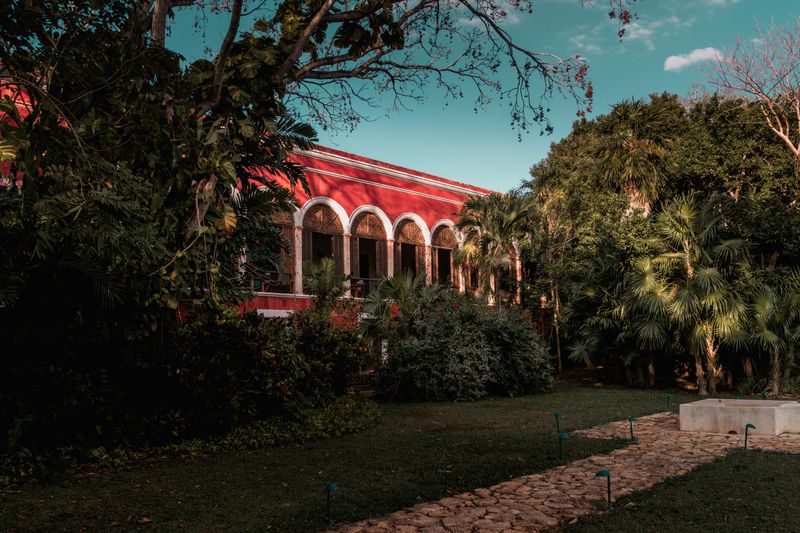
What you see at a henequen hacienda
Most henequen haciendas share the same layout, and knowing it makes any visit easier to read. The core of the estate, the casco, usually includes:
- The casa principal: the owner's house, often with a long arcaded gallery and high ceilings, used only part of the year.
- The casa de máquinas: the machine house with its tall brick chimney, where steam-driven rasping machines, the desfibradoras, stripped the pulp from the leaves.
- Drying yards and warehouses: where the wet fibre was hung in the sun, then pressed into bales.
- The chapel and the tienda de raya: church and company shop, the two buildings that kept workers on the estate.
- Narrow-gauge rails: small platforms called trucks, pulled by mules, carried leaves from the fields to the machines. Some of these lines still run for visitors.
Outside the casco, the workers' village of thatched Maya houses often survives as a small town in its own right.

Which Yucatán haciendas to visit
Dozens of haciendas now receive visitors in some form, but these four show the different sides of the story and fit easily into a day from Mérida. Opening days and fees change, so check directly before you drive out.
| Hacienda | Type of visit | Drive from Mérida | Best for |
|---|---|---|---|
| Yaxcopoil | Museum, self-guided | 40–50 min | Atmosphere and photos, on the way to Uxmal |
| Sotuta de Peón | Guided tour of a working estate | 40–50 min | Seeing the fibre processed |
| Mucuyché | Hacienda grounds and cenotes | About 1 h | A swim with some history |
| Chunkanán (Cuzamá) | Rail-cart ride to cenotes | About 1 h | The old henequen rails in use |
Yaxcopoil
Yaxcopoil sits on the highway from Mérida to Uxmal and is known for its double Moorish-style arched gateway. The estate began as a colonial cattle ranch and switched to henequen during the boom. It is kept as a museum rather than polished into a hotel: you walk through the main house, the machine house and the gardens at your own pace, and the faded rooms show the period better than any restoration. Combine it with the ruins using our guide to Uxmal and the Ruta Puuc from Mérida.
Sotuta de Peón
Near Tecoh, southeast of Mérida, Sotuta de Peón is the place to see henequen processed rather than imagined. Guided tours take you through the fields, usually by mule-drawn truck, show the rasping machinery running and end with a swim in the estate's cenote. Tours run at set times, so book ahead.
Mucuyché
Near Abalá, south of the city, Mucuyché combines a walk through the old hacienda with two cenotes, one of them reached through a stone channel. It suits a hot afternoon better than a history-heavy morning.
Chunkanán and the Cuzamá cenotes
At Cuzamá, the old henequen rails of the Chunkanán estate now carry visitors on horse-drawn trucks to a string of cenotes. The hacienda buildings are secondary here; the ride is the attraction. Our guide to cenotes near Mérida explains how the carts and fees work.

Staying in a hacienda hotel
Since the 1990s many Yucatán haciendas have been restored as hotels, from a handful of rooms run by a family to luxury properties with spas. They are among the most distinctive places to stay in Mexico, but they are a different trip from a hotel in the centre of Mérida.
What to expect
- Rooms in historic buildings: suites are usually set in the main house, the machine house or converted outbuildings, with high ceilings, tiled floors and thick walls that keep out some of the heat.
- Pools in old water tanks: many hotels turned the stone tanks and troughs that once watered the estate into swimming pools.
- Silence and dark skies: you are in a village or in open bush, often 30 minutes to over an hour from Mérida, with birdsong instead of traffic.
- Food on site: outside Mérida there are few restaurants nearby, so you will eat most meals at the hotel.
Before you book
Plan for a car or a transfer, since buses rarely pass the gate and taxis back from rural villages are hard to find at night. Check whether the property hosts weddings, because haciendas are popular event venues and a Saturday party can fill the grounds. Mosquitoes are part of country life in the rainy season, from June to October. Many travellers split the trip: a few nights in the historic centre, then one or two at a hacienda before flying home.

Planning a hacienda day from Mérida
The haciendas are spread across the countryside, so a car gives you the most freedom; the roads are flat and generally good. Two natural routes:
- South, towards Uxmal: Yaxcopoil in the morning, then the ruins of Uxmal, or Mucuyché for a swim on the way back.
- Southeast, towards the cenotes: Sotuta de Peón on a booked tour, then the Cuzamá or Homún cenotes in the afternoon.
Without a car, many group tours on our Mérida tours page combine a hacienda with ruins or cenotes. For more ideas, see our list of day trips from Mérida. Go early in the hot months, carry cash for entrance fees and bring swimwear if a cenote is on the list.
Frequently Asked Questions
What is a henequen hacienda?
A rural estate in Yucatán that grew henequen, an agave whose fibre was used for rope and binder twine, and processed it in its own machine house. Most were built or converted during the boom of the late 19th and early 20th centuries.
Which hacienda near Mérida is best to visit?
For history and atmosphere, Yaxcopoil, on the road to Uxmal. To see the fibre actually processed, Sotuta de Peón near Tecoh. If you mainly want to swim, Mucuyché or the rail carts of Cuzamá.
Can you visit a hacienda without staying there?
Yes. Museum haciendas and working estates take day visitors, and many hacienda hotels also open their restaurants to non-guests. Check ahead, because some only receive visitors with a reservation.
Is it worth staying in a hacienda hotel?
For one or two nights, yes, if you want quiet, history and a pool in the countryside. You will need a car or transfer, and you will be far from Mérida's restaurants and evening events.
auto_awesome Continue exploring Mérida
You Might Also Like
 article Exploring calendar_today Oct 13, 2026
 Beaches Near Mérida: Progreso, Sisal, Chelem & Telchac
The beaches near Mérida are on the Gulf of Mexico, not the Caribbean: shallow, calm and greener. Here is how Progreso, C
 article Travel Tips calendar_today Oct 13, 2026
 How Much Does a Trip to Mérida Cost? What Drives Your Daily Budget
The cost of a trip to Mérida depends on the season, the kind of place you sleep in, how you eat and how many day trips y
 article Travel Tips calendar_today Oct 12, 2026
 How to Get to Mérida: Airport, ADO Buses & Transfers
The easiest way to get to Mérida is to fly into Mérida airport (MID) or take an ADO bus from Cancún, Playa del Carmen or